April 3, 2026. By Wrenn Whitfield.
Oral health and medical care are deeply interconnected, yet they are often delivered in parallel rather than in partnership. For many patients, this separation creates unnecessary barriers to comprehensive care, especially for those already navigating complex medical, social, and economic challenges.
As a third-year dental student working within a free, student-led clinic embedded in a primary care setting, I have had the opportunity to see both the challenges and the potential of bridging this divide. Our patients often face mental illness, substance use disorders, housing instability, and limited access to transportation and insurance. Within this context, the separation between medicine and dentistry becomes more than an inconvenience; instead, it is an added obstacle to receiving timely and effective care.
It is not uncommon for patients to arrive with significant dental pain after multiple emergency department visits that addressed symptoms but not the underlying etiology. Others present with uncontrolled diabetes alongside advanced periodontal disease, or with untreated oral infections that complicate already fragile systemic conditions. These are everyday examples of what happens when oral health and overall health are addressed separately, despite their clear and well-established connection – and it puts patients’ overall health at risk.
Across the United States, nontraumatic dental conditions account for approximately two million emergency department visits each year, representing about 1.5 to 2 percent of all encounters. These visits are often costly and rarely provide definitive treatment. Instead, patients frequently receive temporary relief through analgesics or antibiotics, while the root cause of their condition remains unresolved. This pattern disproportionately affects patients with limited resources, and in safety-net settings, where individuals may also face behavioral health challenges or barriers to health literacy, even small gaps in coordination can lead to delayed care, worsening disease, and preventable complications.
The connection between oral health and systemic health is well established within healthcare research although patients do not understand this interplay as well. Conditions such as periodontitis and untreated dental caries are associated with diabetes, cardiovascular disease, hypertension, and obesity through shared inflammatory and behavioral pathways, and oral inflammation can make glycemic control more difficult and may contribute to increased cardiovascular risk; meanwhile, appropriate dental care can support improved systemic outcomes. Despite this, some patients may not share relevant medical history in a dental setting, or may not mention oral symptoms during medical visits, assuming they are unrelated. This highlights not only a systems gap, but also an opportunity for more unified patient education and communication.
In our clinic, shared electronic health records have provided an important foundation for more coordinated care, particularly for patients who may be unsure of their medical histories or medications. Building on this, we introduced a brief oral health screening tool and referral pathway within primary care workflows, along with targeted education on common dental considerations. These efforts were met with genuine interest, but their implementation also revealed important realities about clinical practice. Primary care providers are already balancing significant demands: managing chronic disease, addressing social determinants of health, and limited visit times, among other challenges. Feedback from our team made it clear that even well-intentioned tools can become burdensome if they are not seamlessly integrated. Length, lack of automation, and additional cognitive load all contributed to limited uptake. These insights were not discouraging; rather, they clarified that successful integration depends as much on design and feasibility as it does on clinical importance.
Several recurring challenges continue to illustrate where more streamlined coordination could make a meaningful difference: dental pain is often managed with temporary measures in the absence of definitive care; there is sometimes uncertainty around antibiotic prophylaxis in medically complex patients; odontogenic sources of symptoms can be difficult to distinguish from other conditions; and medication-related xerostomia can quietly accelerate caries progression. These are not failures of individual clinicians, but reflections of systems that do not consistently support shared knowledge or coordinated workflows.
Encouragingly, even small, thoughtful adjustments can improve this dynamic. For example, streamlined referral tools that focus only on essential information, patient-reported screening incorporated into scheduling or check-in, and automated prompts within existing electronic health record systems can reduce friction rather than add to it. Additionally, brief, reciprocal educational exchanges between medical and dental teams can further strengthen collaboration without requiring significant additional time.
As I prepare to transition from training to practice, I am increasingly aware of how much coordinated care depends on access to shared systems and communication pathways. Without them, clinicians must rely more heavily on incomplete patient histories which leads to opportunities for early intervention may be missed – or more imminently, putting patient health at risk. In contrast, even modest integration within our clinic has made a noticeable difference. Dental and medical providers are better equipped to understand the full context of their patients’ health, referrals are more timely and purposeful, and patients experience care that feels more connected and supportive.
Improving integration between oral health and medical care does not require redefining professional roles. Rather, it calls for thoughtful alignment that creates systems that make collaboration easier and more intuitive. For clinicians, this may mean advocating for referral processes that fit naturally into existing workflows. For healthcare leaders, it includes investing in interoperable systems, automation, and interprofessional education that support coordinated care. Most importantly, it requires recognizing that patients do not experience their health in silos, so their care should not be delivered that way either.
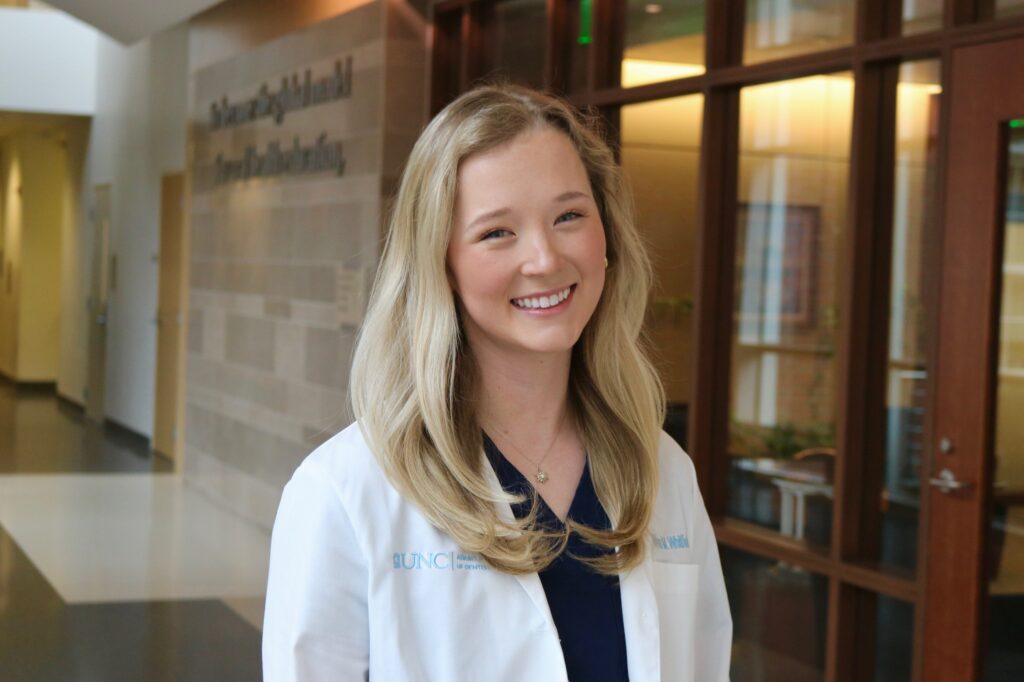
Wrenn Whitfield
UNC Adams School of Dentistry, DDS Class of 2027
2025-2026 BlueCross BlueShield of NC Foundation Albert Schweitzer Fellow
The opinions are the author’s own.